On the last day of June 2020, throngs of Cairo residents queued patiently to enter a small patch of India in a suburb of the Egyptian capital. The doors of Le Palais Hindou (Hindu Palace), or the palace of Baron Empain, have been opened to the public after a $10.9 million renovation by the Egyptian Armed Forces Engineering Authority that took three years. The building, which has been restored to its original copper-red color after appearing beige for decades, was the brainchild of Baron Edouard Empain, the Belgian engineer-turned-industrialist who is best known in Egypt for being the founder of Heliopolis, a town built in the desert near Cairo .
At the reopening, jubilant residents of the Egyptian capital posed for pictures in front of a balustrade of Shiva on Naga and Yali, which seemed to particularly fascinate Cairenes. The building that many claimed to be haunted by the spirit of Empain’s sister, and who allegedly fell to her death from the balcony, slowly fell into disrepair. The palace was changed several times after the 1950s and its previous Saudi owners wanted it converted into a casino. However, its presence indicates the success of Empain, who battled difficult childhood conditions to build a multinational empire.
The making of the baron
Born in Beluel, a small municipality in Wallonia, Belgium, Edward Empain was the first of seven children of a teacher who had difficulty making ends meet. Inspired by the Industrial Revolution, Empain wanted to become an engineer, but his family could only pay for his high school education. Determined to succeed, he reached the university and pursued his dream.
Empain began to emerge in King Leopold II’s Belgium when he founded a company that built public transportation connecting villages to cities.
In 1891, he became one of the first industrialists to use electric motors for urban trams, building electric tram lines in Brussels, Bologna, Lille and other cities in Europe. He achieved fame after coming up with the idea of an electric underground tram in Paris that was later extended to become the city’s metro. His business interests expanded as far as Russia and China and he even tried to set up shop in India, but this was not the case. Unfortunately, Empain’s voyages to India are not well documented, but he appears to have developed an admiration for the country’s temples.
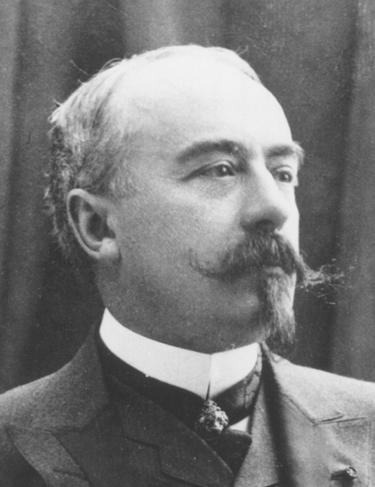
In the early twentieth century, Empain moved to Egypt with the aim of concluding a contract to build a railway linking Matariya to Port Said. He did not win the contract, but decided to stay in the country, where he achieved success when his company was awarded the rights to build the Cairo tram network. The Belgian industrialist, who received the title of baron from King Leopold II, developed a good business relationship with Boghos Nubar Pasha, an Egyptian-Armenian businessman (and son of the country’s first Prime Minister Nubar Pasha), and the two established Heliopolis. Oasis Company.
The company purchased land in the desert near Cairo from the British occupiers to build Heliopolis, a new luxury town. The Belgian businessman came up with the idea to build Heliopolis when he went to the desert on horseback. “I want to build a city here,” Empain told fellow Belgian and famous architect Ernst Gaspard. It will be called Heliopolis, the city of the sun, and above all, I will build a palace there. A huge palace…” Gaspar was commissioned to design the new town, which will contain a mixture of Persian, Moorish, Islamic and European architecture.
Empain wanted the new town to have wide roads, a racetrack, a golf course, and mansions to rival those of the French Riviera.
Architectural styles
In 1907, Empain hired French architect Alexandre Marcel to build his dream home that would look like a Hindu temple. Famous for the international-style buildings he designed, the Frenchman achieved fame for his designs at the 1900 Paris Exposition, where visitors were amazed by his Asian-style designs like the Cambodian Pavilion. Marcel was also wanted in Asia, where he designed the French Embassy in Tokyo and the Maharaja’s Palace in the Indian princely state of Kapurthala.
Marcel was commissioned to build a palace inspired by the Hindu temple of Empain, who wanted to live in a unique palace in Egypt.
Some websites claim that the inspiration for the palace was the Angkor Wat temple in Cambodia, while others claim that the temples of Odisha, northern or southern India were the model. There is also a belief that the 11th century Kandriya Mahadeva Temple in Khajuraho was partly the inspiration for the Empan Palace, while the Sanchi Stupa Gate was a model for the palace gate. The palace actually combined elements from several Indian styles of architecture, and the facades were littered with sculptures of Hindu deities, apsars, and animals. It is possible that Marcel, who was famous for experimenting with different architectural styles, wanted to make the building representative of all Hindu temples in India.
The palace interiors, designed by Georges-Louis Claude, had a much stronger European influence. Although there are a few Hindu and Buddhist statues inside, the idea was for the palace to feel like a palace in Europe. The ground floor had an ornate wooden ceiling with friezes inspired by Greek mythology. The rooms on the upper floor are designed in Baroque, Islamic and Rococo styles. With its wooden floors and golden door handles, the house had Belgian-glazed windows that drew in the maximum sunlight.
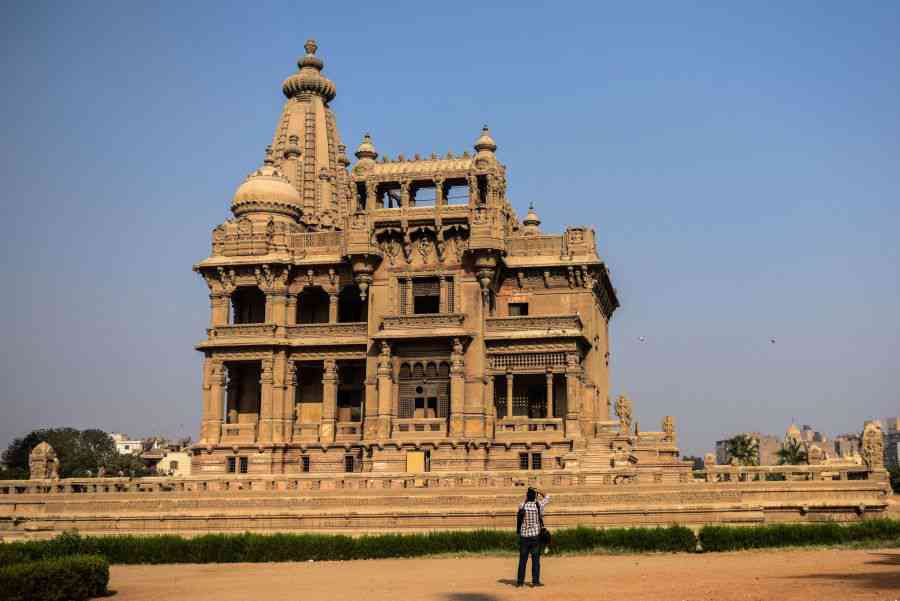
It took four years to build the 12,500 square meter house which was one of the first buildings in Egypt to be made of reinforced concrete, and Empain moved into it in 1911. The terrace and complex of the palace, with its green terraces and marble statues of Greek and Roman mythology, hosted many parties for Cairo’s elite In the period before the First World War. At that time, the invitation to the palace, which stood out among the graceful and grand structures of Heliopolis, was one of the most desirable places in the Egyptian capital.
During the war, Empain was given the rank of major general and was tasked with producing weapons for the Belgian army in Europe. He was also responsible for transport at the front and was wounded while on duty. His business empire continued to grow after the armistice of 1918, and he established several electric companies on different continents.
Empain died in 1929 in Belgium but was buried in the Co-Cathedral of Our Lady of Heliopolis, making his final resting place the town he envisioned and built. Until now, Egyptians fondly remember Empan as the founder of Heliopolis (Heliopolis), the Arabic name for Heliopolis.
Three generations of the family lived in the palace after the death of Edouard Empain. It was sold in 1957 at auction.
Decades of neglect
The house slowly fell into disrepair and the golden door handles and other fixtures disappeared, bats took over its ceilings, and the bathroom found safety and comfort in its spacious interior. It also became a hotspot for criminals and drug dealers over the next few decades.
There have been many stories about the house being haunted by the ghost of Edward Empain’s sister. Neighbors claimed that they heard screams in the night that were attributed to the woman who allegedly fell from the palace to her death. Others claimed that the house was haunted by demons and vampires. In the 1990s, underground concerts were held in the abandoned palace, and many locals believed it was a satanic ritual. And drew the attention of the media and the authorities to the parties, they suppressed and even arrested some musicians.
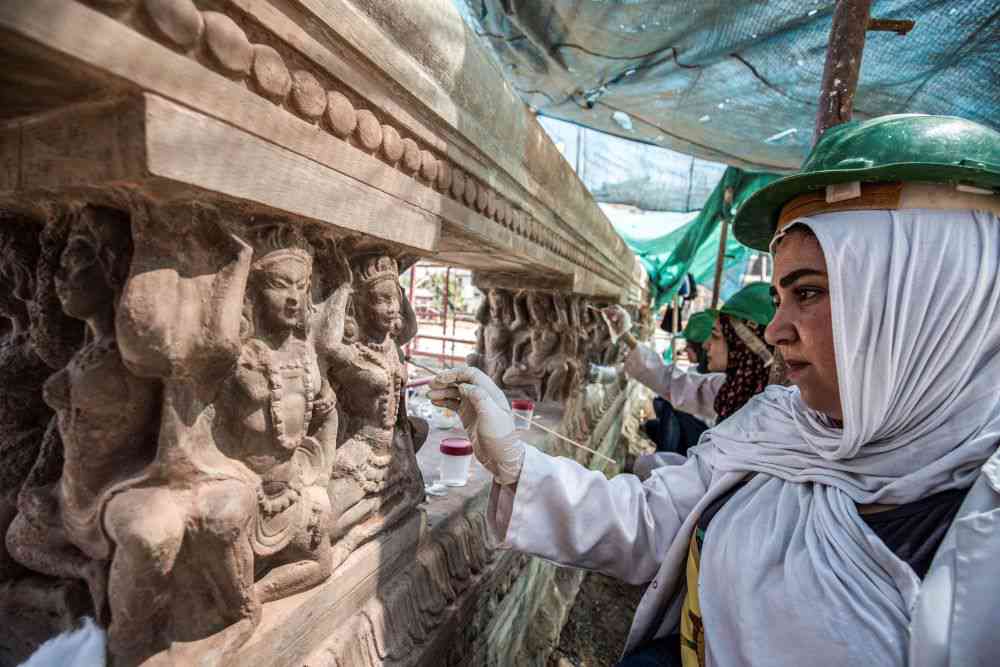
The lack of proper maintenance for decades affected many of the Hindu and Greco-Roman statues in the palace. This state of decline continued for decades, but hopes for a revival of the house were raised in 1993 when it was included in the Egyptian Antiquities List.
The Egyptian government acquired the property in 2005 from its Egyptian-Saudi owner in exchange for land in New Cairo. The renovation of the building began in mid-2017 and included complete repairs to the interior, including restoration of windows and roofs.
Le Palais Hindou is now a museum of local heritage. Since its renovation, it has also become a popular place for pre-wedding photos, especially at night. Restored to its ancient glory, it remains the only Indian-style building in a country with thousands of years of civilized ties.
Ajay Kamalakaran is a freelance writer and journalist based in Mumbai. He is the 2022 Kalbalata Fellow for History and Heritage Writings.
.