The close relationship between art and architecture in modernity

The idea of integrating art and architecture goes back to the origin of the order, however, it took on a new meaning and social purpose during the Avant-Garde movement of the early twentieth century, becoming one of the most defining characteristics of Modernism. This close relationship is evident in the works of some of the greatest contemporary architects, such as Mies van der Rohe, Le Corbusier, and Oscar Niemeyer, to name a few.


 +8
+8
Needless to say, modernity arose from the expectation of the moral and physical reconstruction of a world devastated by war, and served as a tool for strengthening the collective identity, and thus the bond between the city and its inhabitants. In this context, artistic expression is used as a tool for shaping the emotional life of the user, where art and architecture together can give new meaning, offering a place that represents a sense of community, as well as function and technique.
Professional development at the Bauhaus was marked by what Argan (1992) calls “pedagogical rationality,” which encouraged the unification of all arts through GesamtkunstwerkRoughly translated as “a comprehensive work of art,” it includes architecture, painting, sculpture, industrial design, and crafts. This collaboration was expected to take place even on the construction site, thus combining intellectual and manual labor into a common experience. As master exponent Walter Gropius used to say, an architect should be as familiar with drawing as a painter should be with architecture. One should not design a building and commission a sculptor afterwards; This would be wrong and detrimental to the architectural integrity.
Apart from the Bauhaus programme, this integration of the disciplines has also been put forward, most notably, by Le Corbusier through the combination of elements from painting and sculpture with formal concepts of architecture. In this sense, Le Corbusier – though a “solo show” that preached the synthesis of the arts in his designs, but always worked as a solo artist – argued that the roles of architects, painters, and sculptors were equally important to contribute to fruitful collaboration in the real world, that is, on the construction site, Through creation and design in perfect harmony.
To some extent, this inseparable relationship seemed so utopian that Lucio Costa stated that this greatest art would require a level of cultural and aesthetic sophistication almost impossible to achieve, in which architecture, sculpture, and painting constitute one coherent body, the surviving sustenance. An object that cannot be disintegrated. However, the Cabanema Palace in Rio de Janeiro is arguably the closest to this Brazilian utopia relying on painter Candido Portinari, sculptor Bruno Giorgi, and landscape architect Burle Marx since the beginning of the project’s development. As the French historian Yves Bruand says, the result is an ensemble of great artistic value, subtly enhancing and complementing architecture, but subordinate to it at the same time.


While his works have become prime examples of the fusion of architecture and art, Oscar Niemeyer also shared Costa’s view that a true synthesis of the arts can only be achieved in exceptional circumstances. He also stressed the urgent need to form a team working together from the beginning of the architectural plans to amicably discuss the problems of the project and its smallest details, without dividing it into specialized areas but considering it as one balanced entity.
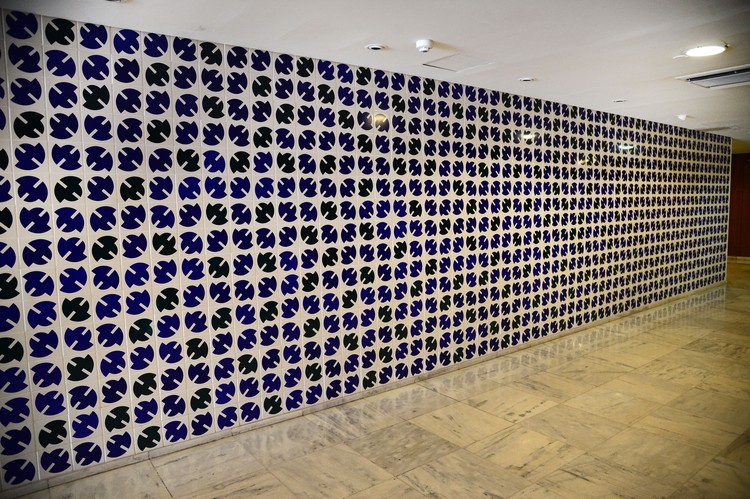
The ideal is to integrate all disciplines from the beginning of the project, but inviting artists to participate later in the design process does not necessarily affect the final result. A good example is the Salão Negro (Black Room) at the National Congress in Brasilia, where artist Athos Bulcão, invited by Niemeyer after completion of the project, created an abstract and simple language using black granite on the floor and white marble on the walls resulting in a perfectly integrated mural With architecture and building materials. This fresco with abstract patterns is often cited by academics, including Paul Damas when he stated that non-figurative language is the best match for modern architecture. In this regard, the author also mentions the semi-figurative bronze sculpture of Maria Martins in the Palácio da Alvorada gardens, highlighting the “formal convergence of the curves” of the statue and the “slender columns of the building”, as an exemplary example of integration.

However, while DAMAZ praises the integration of architecture and art in Oscar Niemeyer’s projects, it rejects one of the most important examples of interdisciplinary integration in the history of Modernism, the UNAM campus in Mexico City. This complex is one of Mexico’s most emblematic architectural achievements, a country considered a pioneer in integrating art into architecture, as evidenced by the mural painting tradition since the 1920s. The campus was opened in 1952, in parallel with CIAM VIII, by more than 100 architects, as well as engineers, artists, and landscape designers. Some of the most remarkable artworks featured in the project are the frescoes of Diego Rivera, David Alvaro Siqueiros, Juan O’Gorman, and Francesco Ibez, which the author has criticized for being allegorical, creating a stylistic contrast between social and functional realism. Architecture, at the expense of the latter. However, despite the criticisms, one cannot ignore the fact that UNAM is an open-air art museum and an example of collaboration and community.

On a different but equally important scale, the integration of art and architecture is done through the inclusion of occasional individual elements such as Mies van der Rohe’s iconic Barcelona Pavilion. In fact, the sculpture the morning, also known as Alba, by German sculptor Georg Kolbe (1877-1947) is not necessary for the pavilion. But what is also important in this new architectural concept, if not only the arrangement of planes and vertical trusses? The pavilion is completely independent of the sculpture, as well as of the materials, however, one cannot imagine it today without this human form with arms outstretched and finely framed for the user experience. As Claudia Cabral beautifully explains, “In Mays’ delicate equilibrium, guided by partial contrasts, and by the system of compensations, sculpture is the only element that has no peer […] Mays decided to place only one statue, one figurative element in his abstract level. Within the wings we play with reflections, transparency and parallels, we are the only potential partners of the bronze figure, we are flesh and blood, the visitors.”
.jpg?1620863172)
Each form of integration of the different disciplines consists of a coherent dialogue between architects, painters and sculptors, both from the beginning of the development of the project and later, during construction, both on a large scale and with individual elements. With that in mind, it is alarming to witness events such as the transfer of paintings by artist Athos Pulkau at Planalto Palace in Brasilia in 2009 due to renovation. Even the Athos Bulcão Foundation – Fundathos has opposed it since the original site was determined by Athos himself, along with Niemeyer while designing the mansion in 1950.
As Rhino Levy once said, architecture is not secondary, but neither is it the mother of all arts. There is only one art and its value is measured by the emotions it evokes in us. Painting and sculpture can be independent, however, when applied to architecture, they become part of a whole. This lesson begins on the collective and shared experiences during project development and touches everyone who has the opportunity to visit the architectural work.
List of references
Argan, Giulio Carlo. modern Art [Modern art]. São Paulo: Cia das Letras, 1992.
Brand, Eve. Contemporary Architecture in Brazil. São Paulo: Perspective, 2010.
Cabral, Claudia Costa. Modern Art and Architecture in Three Projects by Oscar Niemeyer [Art and modern architecture in three projects by Oscar Niemeyer]. DOCOMOMO Brazil, Salvador, 2019.
Cabral, Claudia Costa. Modern architecture and figurative sculpture: representation of nature in modern space [Modern architecture and figurative sculpture: naturalist representation in modern spaces]. DOCOMOMO Brazil, Rio de Janeiro, 2009.
Damaz, Paul. Art in Architecture in Latin America. New York: Reinhold Publishing Corporation, 1963.
DIÓGENES, Beatrice Helena Nogueira; Paiva, Ricardo Alexander. A dialogue between art and architecture in modernity in Fortaleza [Dialogue between art and architecture of modernism in Fortaleza]. Docomomo Brazil, Recife, 2016.
Tavares, Camila Christiana de Aragon. Integration of Art and Architecture in Brasilia: Lucio Costa and Athos Bulcão [The integration of art and architecture in Brasília: Lucio Costa and Athos Bulcão]. Master’s thesis [Master’s Thesis] Union National Bank, Brasilia.
This article is part of the ArchDaily topic: Collective Design. Every month we explore a topic in depth through articles, interviews, news and projects. Learn more about our monthly topics. As always, at ArchDaily we welcome contributions from our readers; If you would like to submit an article or project, contact us.
.