It has been said that technology is the answer to the climate crisis. By ultimately decoupling economic growth from its effects on the environment through improved energy efficiency, the argument continues, better technology promises to prevent catastrophic global warming.
But among the many things this argument fails to take into account is the fact that new technology has often encouraged exorbitant forms of consumption: from cars and private planes to kitchens stocked with appliances and air conditioners in countries with temperate climates.
The technology has also caused the so-called “rebound effect”: improving energy efficiency leads to cheaper energy and therefore higher rates of energy consumption. For example, buying a more fuel-efficient car will reduce your average fuel cost per trip and therefore likely lead to more trips, reducing at least some of the expected energy savings.
A similar trend is emerging in architecture, where advances in artificial cooling and heating and computer-aided design – rather than creating more efficient designs – have introduced already wasteful building patterns.
In my work, I call this phenomenon the “architectural rebound effect”. This effect is particularly evident when we look at how building facades (the “skin” that covers buildings) have evolved over the past 100 years.
Interface failure
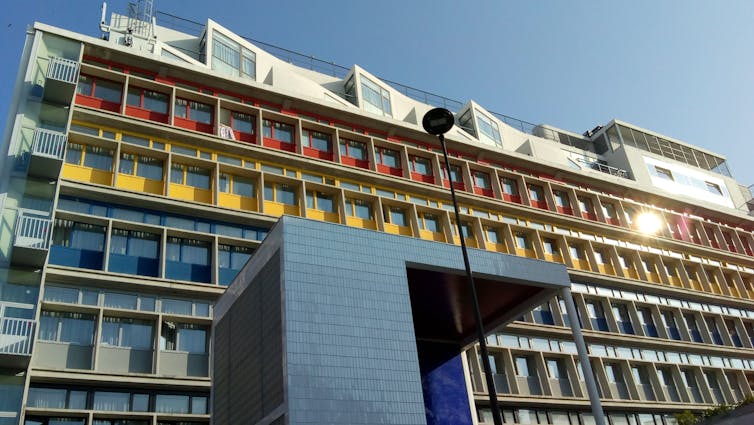
The Cité de Refuge apartment building in Paris, designed by the Swiss-French architect Le Corbusier in 1933, features one of the earliest examples of an all-glass facade. But with no windows or air conditioning, summer interior temperatures reached 33°C – making it a “remarkable failure” of the architecture.
To fix this, the facade was fitted with external shading devices and about a third of its glass was made opaque. This strategy was mostly effective: Computer simulations showed that the upgraded design lowered summer temperatures below 25°C.
Since the 1950s, all-glass facades without shading devices began to dominate the city skyline thanks to efficient and inexpensive air conditioning systems that allowed temperatures to be regulated inside these buildings.
But these new glass boxes came with their own set of environmental problems. For example, research has shown that office buildings built in New York’s Manhattan borough between 1965 and 1969 consume twice as much energy per unit floor area as those built between 1950 and 1954.
One reason for this may be the difference in window-to-wall ratio between these groups of buildings. While the proportion of later buildings was between 53% and 72%, the proportion of earlier buildings ranged from 23% to 32%. This means that more heat was allowed in and out of the former group of buildings during summer and winter, increasing their need for cooling and artificial heating.
Ian Tom Ferry / Wikimedia
Another problem with all-glass facades is the excessive glare they cause indoors, which means that interior blinds have to be pulled out most of the time. This blocks occupants’ view of the outside and increases reliance on artificial lighting, further increasing energy consumption.
These problems with all-glass facades still plague buildings today. Now, parametrically designed shaders are often used as a solution. Unfortunately, these tend to obscure the outside views of the workers inside, while maintaining the need for artificial lighting.
restriction of liberties
Should we prevent architects from exercising their aesthetic freedom in designing these extravagant buildings that harm our planet? One solution might be to set a cap on the amount of energy the building is allowed to consume. This will require architects to use passive design strategies – techniques that enable humans to live in challenging climates without expending unnecessary energy.
For example, by 400 BC, the Persians had devised an ingenious method of storing ice during the hot summer months using ice pits called “yakhshal”. These were vaulted tanks up to 15 meters high and about six meters deep.
By letting hot air escape through an opening at the top of the tank and burying the ice deep in the ground, the base of the yachal—and the ice inside—will stay cool all summer.
An example from the modern era is the building of the Inspector General of Police Complex in Gulbarga, India, which uses a wind tower fitted with water jets to create a comfortable environment in a hot and humid climate. The droplets from the nebulizer absorb heat from the incoming air, reducing the air temperature by up to 13°C before it enters the building.
It is first necessary to determine how best to measure the maximum energy limit of buildings. In current building energy rating schemes, ‘energy intensity’ is often used, which refers to the amount of energy consumed per unit floor area.

Jin Meng / Wikimedia
But the drawback of this scale is that it allows very large and luxurious buildings to receive low-energy certification. A more appropriate measure could focus on energy consumed in relation to the number of people using a building—in other words, the building’s energy use per person.
Create masterpieces
A possible objection is that this may result in “boring” buildings without aesthetic appeal. In this case, we can encourage architects to express their creativity by building structures that are not designed to house people and therefore require little operational energy to operate.
This would significantly reduce the environmental impact of these architectural masterpieces. On average, 80% to 90% of a building’s carbon emissions arise from its operation, not its construction.
Moreover, many famous buildings have failed to function as they were designed to. Mies von der Rohe’s new National Gallery in Berlin has suffered from cracked windows and heavy condensation, while Frank Gehry’s MIT’s Stata Center in Massachusetts has leaking roofs and excessive mold. However, these buildings were not demolished, but left standing as examples of high-quality design.
Perhaps if architects channel their desire for aesthetic audacity into sculptural-like structures rather than buildings designed for habitation, they can continue to push the boundaries of design without pushing the planet.